Direct Answer
What is the short answer?
Ignoring cybersecurity can cost your business everything. Learn the real risks, hidden costs, and how to protect your digital future today.


Build Something Exceptional
Web, software, mobile, and growth systems tailored to your business.
Ignoring cybersecurity can cost your business everything. Learn the real risks, hidden costs, and how to protect your digital future today.
Direct Answer
Ignoring cybersecurity can cost your business everything. Learn the real risks, hidden costs, and how to protect your digital future today.
Article Context
Category
cybersecurity
Author
Janon Emersion T
Reading Time
7 min read
Key Takeaways
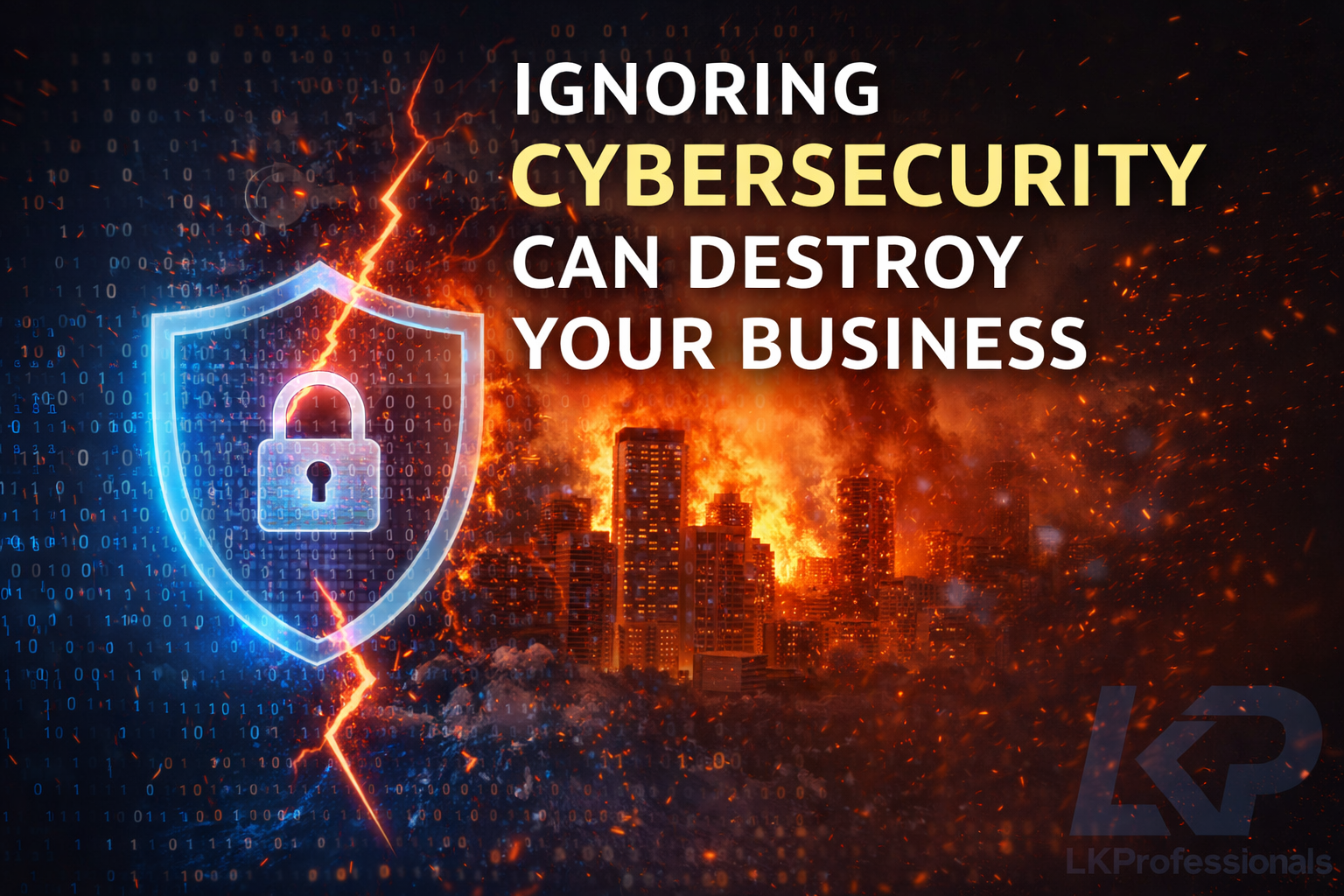
Ignoring cybersecurity isn’t a minor oversight — it’s a strategic failure that can dismantle your entire business.
This in-depth guide reveals the real risks, hidden costs, and why security must be built from day one.
The Illusion of “We’ll Handle It Later”
There is a dangerous pattern quietly unfolding across businesses of all sizes — from solo founders building their first MVP to enterprises managing global infrastructure. It begins with a simple assumption:
“We’ll deal with cybersecurity later.”
Later never comes. But the breach always does.
In today’s hyperconnected, AI-accelerated, automation-driven landscape, cybersecurity is no longer a technical afterthought — it is a core business function . Yet, ironically, the very tools meant to accelerate innovation — AI code generators, rapid deployment frameworks, plug-and-play integrations — are now becoming the fastest pathways to vulnerability.
The harsh reality? Cybersecurity is not something you add . It is something you either build into your system from day one… or pay for exponentially later .
This is not a fear-driven narrative. It’s a pattern. A predictable, repeatable collapse sequence that plays out in businesses that underestimate digital risk.
Let’s break it down — strategically, practically, and without sugar-coating the truth.
The Modern Business Runs on Trust — and Trust is Fragile
Every digital business operates on an invisible contract: trust.
Your customers trust that:
Their data is safe
Your platform is reliable
Your systems won’t betray them
The moment that trust is broken, the damage is not linear — it is exponential.
A cybersecurity breach doesn’t just expose data. It exposes weakness in leadership, process, and foresight . And in a world where reputation spreads faster than facts, perception becomes reality.
The uncomfortable truth is this: Most businesses don’t lose customers because of competition. They lose them because of lost confidence .
The Startup Blind Spot: Speed Over Security
Startups operate with urgency. Build fast. Launch faster. Iterate endlessly.
Security? That’s “phase two.”
This mindset is not just flawed — it is strategically reckless.
Consider a typical scenario:
A startup launches an AI-powered SaaS platform. The backend is stitched together using multiple APIs, open-source components, and auto-generated code. Authentication is basic. Validation is minimal. Logging is inconsistent.
Everything works. Growth begins.
Then one day, an attacker exploits a simple vulnerability — an exposed API endpoint with no rate limiting.
Within hours:
User data is scraped
Accounts are compromised
Internal systems are accessed
The founders scramble. Damage control begins.
But here’s the reality: You don’t get a second chance at first trust.
Startups often believe they are too small to be targeted. In truth, they are perfect targets — easy, exposed, and unprepared.
The AI Problem No One Wants to Talk About
AI has democratized development. That’s the headline.
But beneath the surface, it has also democratized bad security practices .
Developers now:
Generate code without fully understanding it
Deploy systems without reviewing security implications
Integrate third-party tools without validation
AI doesn’t guarantee secure code. It guarantees fast code .
And fast code, without governance, becomes a liability.
Imagine this:
A developer uses AI to generate an authentication system. It works perfectly in testing. It even passes basic validation.
But hidden within the logic is a flaw — a predictable token pattern.
An attacker identifies it within minutes.
Now multiply that across thousands of businesses relying on similar shortcuts.
The result? A systemic vulnerability ecosystem .
AI is not the problem. Unquestioned reliance on AI is.
The Real Cost of a Breach: It’s Not What You Think
Most businesses calculate cybersecurity cost incorrectly.
They think:
“Security tools are expensive”
“We’ll invest when we grow”
What they don’t calculate is the true cost of failure .
Let’s be blunt.
A breach doesn’t cost you just money. It costs you:
Operational downtime — systems offline, revenue halted
Customer churn — users abandoning your platform overnight
Recovery costs — forensic analysis, system rebuilds
Brand damage — long-term trust erosion
Legal exposure — compliance violations, lawsuits
In many cases, the total damage exceeds years of revenue .
And here’s the kicker:
Most of this damage is not visible immediately . It unfolds over months, sometimes years.
Cybersecurity is one of the few areas in business where prevention is dramatically cheaper than recovery — yet consistently ignored.
SEO, Reputation, and the Invisible Fallout
Here’s an angle most businesses never consider:
Cybersecurity directly impacts SEO and digital visibility .
A compromised website can:
Be injected with spam content
Redirect users to malicious pages
Get blacklisted by search engines
Suddenly, your rankings disappear. Your traffic drops. Your credibility collapses.
And even after recovery, the shadow lingers.
Search engines remember. So do users.
What took years to build can be dismantled in days — not by competition, but by negligence.
The Domino Effect: One Weak Link is Enough
Cybersecurity is not about building an impenetrable fortress. It’s about eliminating weak links.
Because attackers don’t break the strongest part of your system. They exploit the weakest, most overlooked component .
A single vulnerability can cascade into a full-scale breach.
Examples include:
An outdated plugin
A misconfigured server
A weak admin password
An unsecured API
Individually, these seem minor. Collectively, they form a critical attack surface .
Security is not a feature. It is a system-wide discipline.
Why Businesses Still Ignore Cybersecurity
Despite the risks, many businesses continue to deprioritize security.
Why?
Because cybersecurity suffers from a perception problem.
It is:
Invisible when done right
Painfully obvious when ignored
Decision-makers often operate on short-term incentives:
Launch faster
Reduce costs
Focus on visible growth
Security, by contrast, is a long-term investment with no immediate ROI — until something goes wrong .
There’s also overconfidence:
“We’re not big enough.” “We don’t handle sensitive data.” “We’ve never been attacked.”
These are not defenses. They are assumptions waiting to be disproven .
The Enterprise Paradox: Secure, Yet Still Vulnerable
Large enterprises invest heavily in cybersecurity.
And yet, breaches still happen.
Why?
Because complexity introduces new risks:
Multiple systems
Distributed teams
Legacy infrastructure
Human error
Even with advanced tools, a single misconfiguration can open the door.
The lesson here is clear:
Cybersecurity is not about how much you spend . It’s about how well you integrate security into your operations .
Security is Not a Tool — It’s a Culture
This is where most businesses fundamentally misunderstand cybersecurity.
They treat it as:
A plugin
A firewall
A one-time setup
In reality, cybersecurity is a culture of discipline .
It requires:
Continuous monitoring
Regular updates
Developer awareness
Process integration
It is not something you “complete.” It is something you maintain relentlessly .
What a Secure Business Actually Looks Like
A secure business does not look flashy.
It looks controlled, structured, and intentional .
It has:
Strong authentication mechanisms
Regular backups and recovery plans
Secure coding practices
Infrastructure monitoring
Controlled access levels
More importantly, it has awareness .
Because tools can fail. Processes can break. But awareness catches what systems miss.
Strategic Insight: Security as a Competitive Advantage
Here’s a perspective shift most businesses overlook:
Cybersecurity is not just protection. It is positioning .
In a world where data breaches are common, a secure business stands out.
It signals:
Reliability
Professionalism
Long-term thinking
Clients, especially at higher levels, don’t just buy services. They buy confidence .
And cybersecurity is one of the strongest signals of that confidence.
The Reality Check: You Are Already a Target
Let’s remove one final illusion.
You are not “too small” to be attacked. You are simply not attacked yet — or not aware that you already have been .
Automated bots scan the internet continuously. They don’t care about your size. They care about your vulnerabilities .
If your system is exposed, it will be found. If it can be exploited, it will be.
This is not pessimism. It is operational reality.
Conclusion: Build Secure or Prepare to Rebuild
Cybersecurity is not optional. It is not a luxury. It is not a future concern.
It is a present-day business requirement .
Ignoring it does not delay the problem. It amplifies it.
Every system you build without security becomes a liability. Every shortcut becomes a future incident. Every assumption becomes a potential failure point.
The question is not whether cybersecurity matters. The question is whether your business can survive without it.
For most, the answer is simple:
It can’t.
A Strategic Note from LKProfessionals (Pvt) Ltd.
At LKProfessionals (Pvt) Ltd., cybersecurity is not treated as a separate service — it is embedded into every layer of development, deployment, and maintenance.
Because real-world systems don’t fail due to lack of features. They fail due to lack of foresight.
Whether building applications, managing infrastructure, or scaling digital platforms, the approach remains consistent:
Security is not added later. It is built from the start.
And in a landscape where one vulnerability can undo years of progress, that philosophy is not just valuable.
It is essential.
Apply This Insight
Need implementation support? Talk to LKProfessionals about turning this strategy into measurable business outcomes.
Related Services
Related Insights

Business Growth & Strategy
A practical guide to choosing a software partner in Jaffna for business owners comparing development partners, with clear advice from the perspective ...
Read article
Custom Software & ERP
A practical guide to moving beyond generic software for companies with workflow complexity, with clear advice from the perspective of LKProfessionals ...
Read article
Custom Software & ERP
A practical guide to planning ERP investment for growing operational businesses, with clear advice from the perspective of LKProfessionals and the rea...
Read articleRequest Quote