Direct Answer
What is the short answer?
Discover how offshore teams help businesses scale globally, reduce costs, and gain competitive advantage with real-world strategies and insights.


Build Something Exceptional
Web, software, mobile, and growth systems tailored to your business.
Offshore & Outsourcing Insights
Discover how offshore teams help businesses scale globally, reduce costs, and gain competitive advantage with real-world strategies and insights.
Direct Answer
Discover how offshore teams help businesses scale globally, reduce costs, and gain competitive advantage with real-world strategies and insights.
Article Context
Category
Offshore & Outsourcing Insights
Author
Janon Emersion T
Reading Time
6 min read
Key Takeaways
The Brutal Truth About Staying Local
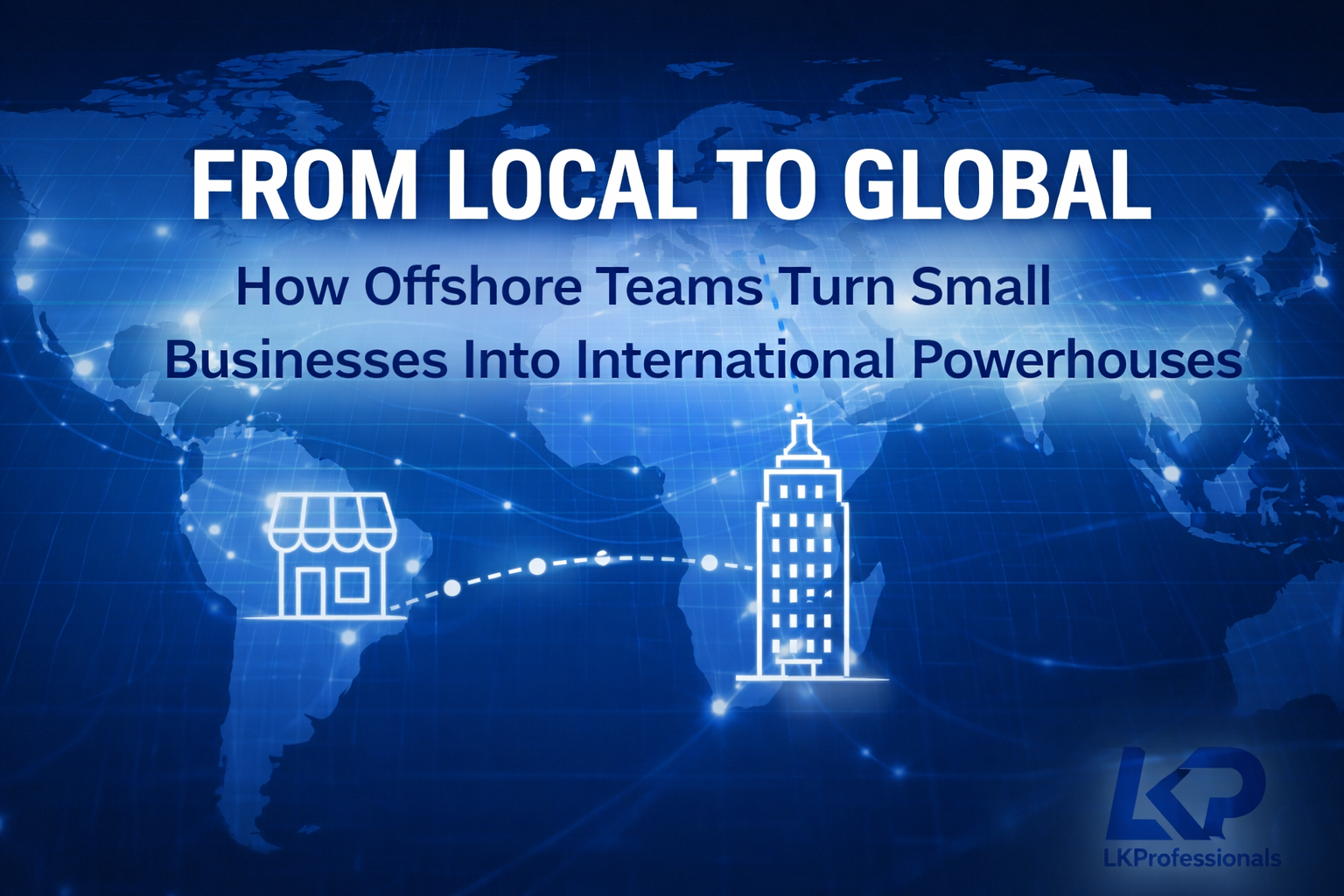
There’s a quiet myth circulating in business circles—especially among small and mid-sized companies—that growth is a function of geography. That to scale, you must expand physically, hire locally, and build slowly.
That thinking is outdated.
The world has already shifted. Technology has flattened borders, redefined talent access, and dismantled traditional barriers to entry. Yet many businesses remain stuck in a local mindset, operating with local limitations, local costs, and local thinking.
Meanwhile, a different class of companies—leaner, faster, and more strategic—are building global capabilities without ever opening a second office.
Their secret isn’t capital.
It’s offshore teams.
Not as a cost-cutting tactic—but as a strategic growth engine .
And if you’re still treating offshore outsourcing as “cheap labor,” you’re already behind.
The Real Definition of “Going Global” in 2026
Going global used to mean expansion—new offices, new hires, new markets.
Today, it means something far more efficient.
It means building a business that can operate, deliver, and compete internationally—without geographic dependency .
A small agency in Sri Lanka can serve clients in the UK, Australia, and Canada simultaneously. A startup can launch products globally with a distributed development team. A service business can scale operations without increasing fixed overhead.
The world is no longer divided by borders—it’s divided by capability and strategy .
And offshore teams sit at the center of that transformation.
Why Most Businesses Still Get Offshore Teams Completely Wrong
Let’s be blunt.
Most companies don’t fail with offshore teams because offshore doesn’t work. They fail because they approach it with the wrong mindset.
The biggest misconception?
That offshore teams lack skill.
This assumption is not only outdated—it’s dangerous.
Because while one company hesitates, another builds a high-performance global team and moves twice as fast.
Countries like Sri Lanka, India, and others are producing highly capable developers, marketers, and engineers. The issue isn’t talent—it’s perception .
And perception delays action.
The Contrarian Truth: Offshore Isn’t About Cost—It’s About Leverage
Yes, offshore teams reduce costs.
But if that’s your primary focus, you’re missing the bigger play.
Offshore is about leverage.
It allows businesses to:
Access global talent pools
Execute faster
Operate across time zones
Scale without traditional constraints
The companies winning today aren’t the ones saving money.
They’re the ones moving faster than their competitors .
And offshore teams make that possible.
From Sri Lanka to the World: A Real-World Perspective
At LKProfessionals (Pvt) Ltd., the journey has never been theoretical.
From working with UK-based platforms like theparkingdeals.co.uk and bestparkride.co.uk, to collaborating with Australian businesses such as tnkpropertyservices.com.au, the model has been proven repeatedly.
Different industries. Different markets. Same outcome.
Results.
From building complete business ecosystems—from logo creation to full-scale web platforms—to executing SEO strategies and custom software development, the pattern is consistent:
Clients often begin with doubt.
They end with surprise.
Because the expectation gap is real—and closing that gap is where trust is built.
Trust: The First Barrier You Must Break
Let’s address the elephant in the room.
Trust is the biggest challenge in offshore relationships.
Not pricing. Not quality. Not communication.
Trust.
Clients worry:
“Will they understand my business?”
“Will the quality match?”
“Can I rely on them long-term?”
These are valid concerns.
But here’s the reality—trust is not built through promises. It’s built through execution .
Deliver once. You’re a vendor.
Deliver consistently. You’re a partner.
At LKProfessionals, trust is established not through sales pitches, but through work that speaks for itself—often exceeding expectations that were already low to begin with.
Communication Isn’t the Problem—Structure Is
Many blame offshore failures on communication issues.
Language barriers. Time zones. Cultural differences.
But in reality, communication breakdowns are usually a symptom—not the root cause.
The real issue?
Lack of structure.
When communication is centralized, consistent, and transparent, offshore teams become easier to manage than local ones.
Using tools like WhatsApp for real-time collaboration, maintaining dedicated client groups, and integrating internal project management systems allows clients to stay continuously informed.
No guessing.
No silence.
No confusion.
Just clarity.
Time Zones: The Hidden Advantage Nobody Talks About
Most businesses see time zones as a challenge.
Smart businesses see them as an advantage.
Operating from Sri Lanka, with working hours strategically aligned from 10 AM to midnight, allows coverage across multiple global markets.
While one region sleeps, another progresses.
Work doesn’t stop—it continues.
This creates a powerful cycle of productivity that local-only teams simply cannot replicate.
The “Zero to Hero” Model: Building Entire Businesses Offshore
One of the most underestimated capabilities of offshore teams is their ability to build complete business ecosystems.
Not just tasks.
Not just projects.
Entire businesses.
From brand identity and website development to digital marketing strategies and system architecture—offshore teams can take an idea and turn it into a fully operational entity.
This isn’t outsourcing.
This is business building .
And it’s happening more often than most realize.
When Offshore Teams Make Absolute Business Sense
Offshore teams are not just for startups.
They’re for any business that values efficiency, scalability, and strategic growth.
They work exceptionally well for:
Startups looking to scale quickly without burning capital
Agencies needing to expand service offerings
Established companies aiming to optimize costs without sacrificing quality
Businesses entering new markets
In industries like e-commerce, healthcare, finance, property services, and retail, offshore teams are no longer optional—they’re becoming standard.
When Offshore Teams Are a Bad Idea (Yes, It Happens)
Let’s not pretend offshore is perfect.
There are situations where it doesn’t work.
If a company:
Lacks clear processes
Cannot manage remote teams
Expects instant results without onboarding
Chooses purely based on price
Then offshore will fail.
Not because of the model—but because of execution.
Offshore amplifies your systems.
If your systems are weak, offshore exposes it.
Cheap vs Premium Offshore: A Critical Distinction
There’s a dangerous segment of the market chasing the lowest price.
And they pay for it later.
Cheap offshore services often lead to:
Poor quality
Missed deadlines
Communication breakdowns
Project failures
Premium offshore services, on the other hand, focus on:
Value delivery
Strategic alignment
Long-term partnerships
Consistent results
The difference isn’t cost.
It’s mindset.
And serious businesses understand this.
The Future of Offshore Teams: AI, Automation, and Global Talent
The next evolution of offshore teams is already underway.
AI will not replace offshore teams.
It will amplify them.
Teams that integrate AI into development, marketing, and operations will deliver faster, smarter, and more efficiently.
Countries like Sri Lanka are positioned to become key players in this ecosystem—combining technical expertise with cost efficiency and global adaptability.
The future belongs to businesses that can blend human talent with intelligent systems across borders .
Strategic Takeaways: How to Actually Make Offshore Work
If there’s one thing to take away, it’s this:
Offshore is not a shortcut.
It’s a strategy.
To make it work:
Focus on value, not just cost
Build structured communication systems
Choose partners, not vendors
Start small, then scale
Prioritize quality from day one
Businesses that treat offshore as a long-term capability—not a temporary fix—are the ones that win.
Conclusion: The World Is Already Global—Are You?
The shift has already happened.
The question is whether your business has caught up.
Staying local is no longer a limitation of geography—it’s a limitation of mindset.
Offshore teams are not just an operational decision.
They are a strategic move toward becoming a global business.
And in a world where speed, efficiency, and adaptability define success, the companies that embrace this model will lead.
The rest will follow.
A Strategic Partner for Global Growth
For businesses looking to move beyond theory and into execution, partnering with the right offshore team makes all the difference.
LKProfessionals (Pvt) Ltd. operates at the intersection of cost-efficiency, technical excellence, and global delivery capability—helping businesses transition from local operations to international performance.
Not as a vendor.
But as a growth partner.
Apply This Insight
Need implementation support? Talk to LKProfessionals about turning this strategy into measurable business outcomes.
Related Services
Related Insights

Offshore & Outsourcing Insights
A practical LKProfessionals guide to offshore software development partner for UK businesses, with clear decision criteria, common risks, and the comm...
Read article
Offshore & Outsourcing Insights
A practical LKProfessionals guide to SaaS product development partner, with clear decision criteria, common risks, and the commercial questions busine...
Read article
Offshore & Outsourcing Insights
Discover how smart companies leverage offshore teams strategically to scale faster, reduce costs, and gain competitive advantage.
Read articleRequest Quote