Direct Answer
What is the short answer?
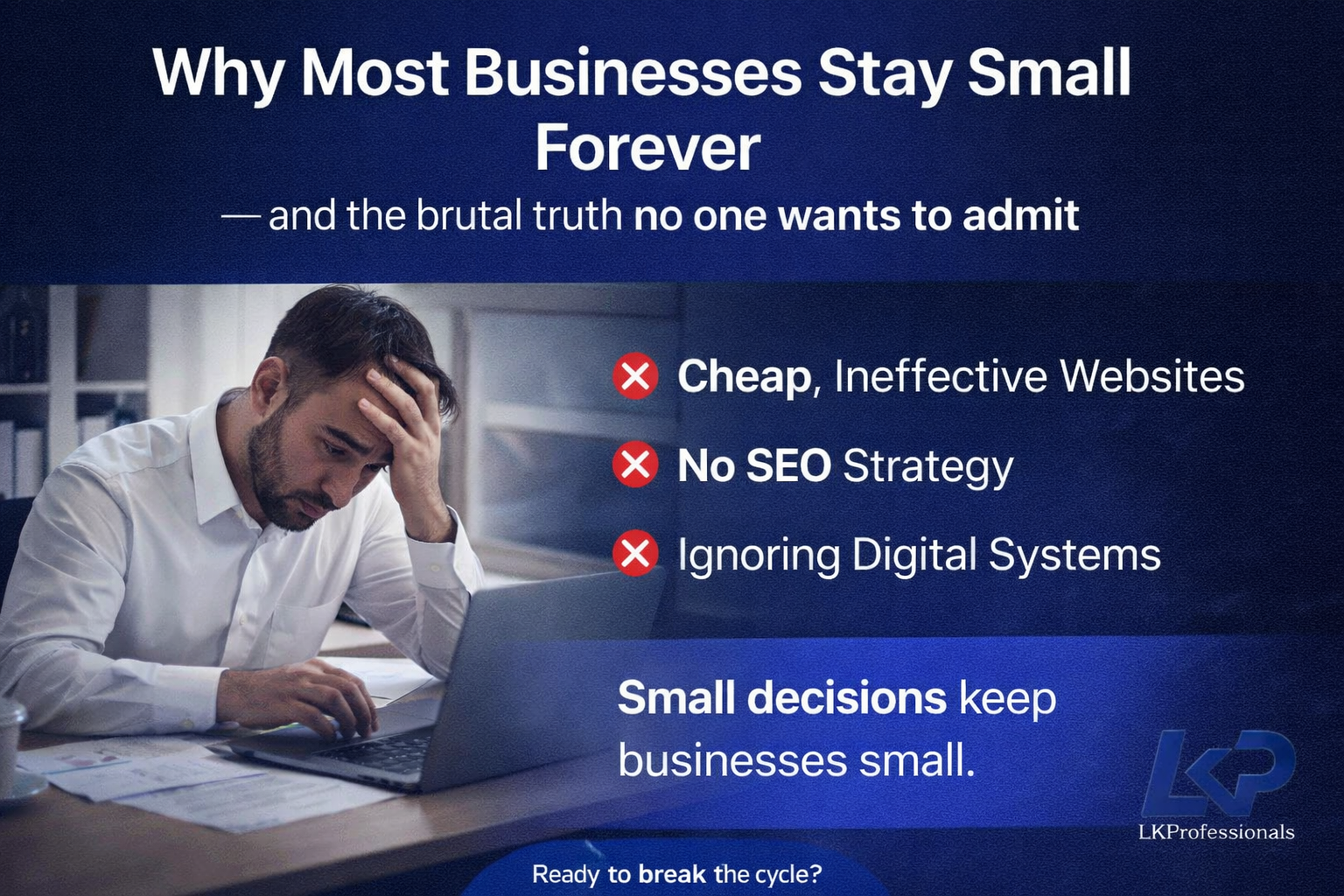
Discover why most businesses stay small forever and how poor decisions, lack of SEO, and outdated systems block real growth.


Build Something Exceptional
Web, software, mobile, and growth systems tailored to your business.
Discover why most businesses stay small forever and how poor decisions, lack of SEO, and outdated systems block real growth.
Direct Answer
Discover why most businesses stay small forever and how poor decisions, lack of SEO, and outdated systems block real growth.
Article Context
Category
Business Growth & Strategy
Author
Janon Emersion T
Reading Time
7 min read
Key Takeaways
Most businesses don’t fail—they just never grow.
Discover the real reasons why businesses stay small forever and how poor decisions, lack of SEO, and outdated systems silently kill growth.
The Illusion of “Trying” vs the Reality of Growth
Walk into any market, scroll through any directory, or browse through local listings, and you’ll see thousands of businesses. Some have been around for years—decades, even. Yet, despite time passing, effort being invested, and money being spent, they remain exactly where they started.
Small. Static. Stuck.
Here’s the uncomfortable truth: most businesses don’t fail because of competition, market conditions, or lack of opportunity. They fail to grow because of their own decisions.
Not bad luck. Not timing. Not “the economy.”
Decisions.
More specifically— the refusal to evolve.
In a world where technology, systems, and digital leverage define growth, many businesses still operate as if it’s 2005. They build cheap websites, avoid strategic investments, resist automation, and convince themselves they’re “saving money”—when in reality, they’re quietly capping their own growth.
This isn’t a motivational article. This is a reality check.
If a business hasn’t grown in 2–3 years, it’s not stuck. It’s choosing to stay small.
Let’s start where most businesses go wrong—right at the beginning.
They don’t invest. They spend.
There’s a difference.
Spending is reactive. Investment is strategic. And most businesses, especially small ones, choose the cheapest option every single time.
Cheap website
Cheap developer
No SEO
No strategy
No long-term thinking
What they get is exactly what they paid for—a digital presence that does nothing.
A website that doesn’t generate leads is not an asset. It’s a digital brochure collecting dust.
And yet, businesses proudly say: “We have a website.”
That’s like saying you own a gym membership but never show up.
Let’s call it what it is.
Most businesses are not avoiding technology because it’s expensive. They’re avoiding it because they don’t understand it.
And what we don’t understand, we fear.
This fear shows up in subtle ways:
“We don’t need automation yet.”
“Manual is fine for now.”
“We’ll upgrade later.”
Later never comes.
Meanwhile, competitors who embrace systems, automation, and digital tools quietly build momentum. They move faster, operate leaner, and scale without friction.
The gap widens—not overnight, but relentlessly.
And one day, the “small business” realizes they’re no longer competing in the same league.
Here’s one of the biggest misconceptions in modern business:
“If I have a website, I’m online.”
No. You’re just visible—barely.
A poorly built website without SEO, structure, or strategy is invisible where it matters most: search engines.
Businesses often:
Build a cheap site once
Never update it
Never optimize it
Never track performance
Then they say, “Websites don’t work.”
That’s like buying a car without fuel and saying, “Cars don’t move.”
When done right, a website becomes:
A 24/7 salesperson
A lead generation engine
A brand authority builder
But without SEO, content, and continuous optimization— it’s just decoration.
Over 50% of businesses today still ignore SEO entirely.
Let that sink in.
In an era where customers search before they buy, businesses are choosing to remain invisible.
SEO is not optional. It’s infrastructure.
When SEO is done correctly:
The right audience finds you
Leads become consistent
Conversion rates improve
Revenue scales predictably
Growth stops being random. It becomes engineered.
But most businesses treat SEO like an afterthought—or worse, a one-time task.
It’s neither.
SEO is a long-term growth system. Not a checkbox.
Here’s where things get brutally honest.
Most business owners know what they should do.
They’ve heard about:
SEO
Automation
Digital marketing
Systems
But they don’t execute.
Why?
Because execution requires:
Discipline
Investment
Consistency
Accountability
And that’s where things break down.
Instead, they default to:
“I’ll do it later.” “I can manage it myself.” “It’s not urgent.”
Meanwhile, months pass. Years pass.
And the business stays exactly where it is.
Growth doesn’t come from knowing. It comes from doing. Repeatedly.
This mindset has killed more growth than competition ever will.
The belief that:
“I can handle everything myself.”
It sounds efficient. It feels cost-saving.
In reality, it’s a bottleneck.
When the founder is:
The marketer
The developer
The salesperson
The operator
The business cannot scale beyond the founder’s time and energy.
And time, unlike ambition, is limited.
Scaling requires leverage.
Leverage comes from:
Systems
Teams
Technology
Without these, growth hits a ceiling.
And stays there.
Many small businesses operate with:
No SOPs
No automation
No structured workflows
Some still manage accounts manually or rely entirely on spreadsheets.
That’s not efficiency. That’s survival mode.
Systems are not a luxury. They are the foundation of scale.
Without systems:
Time is wasted
Errors increase
Growth becomes messy
With systems:
Processes become repeatable
Teams become efficient
Scaling becomes possible
The difference is night and day.
Yet many businesses resist building systems because it feels like “extra work.”
It is.
But it’s the kind of work that creates freedom later.
Ironically, businesses that avoid investing in growth often lose far more in the long run.
They:
Underprice their services
Avoid reinvestment
Choose short-term savings over long-term gains
The result?
They remain trapped in low-margin operations.
Growth requires capital allocation.
Not reckless spending—but strategic investment .
The businesses that grow are not the ones that spend the least. They’re the ones that invest the smartest.
Let’s talk about control.
Many founders don’t scale because they don’t want to let go.
They want:
Full control
Direct involvement in everything
Zero dependency on others
It sounds disciplined.
In reality, it’s limiting.
A business cannot grow if every decision, every task, and every process depends on one person.
At some point, leadership must evolve from doing everything to building something that runs without you.
If that shift doesn’t happen, growth doesn’t happen.
Hiring is one of the most misunderstood aspects of growth.
Some businesses avoid hiring because they fear costs.
Others hire too quickly without strategy.
Both lead to problems.
The truth is:
Hiring late slows growth
Hiring wrong damages growth
What’s required is intentional hiring.
Not just filling roles—but building capability.
A business that wants to scale must invest in people who can:
Execute
Innovate
Take ownership
Without that, the founder remains the engine—and the limitation.
Here’s a truth most won’t admit:
Some businesses don’t grow because they don’t want to.
Not consciously. But subconsciously.
Growth brings:
Complexity
Responsibility
Risk
Pressure
Staying small feels safe.
Predictable. Manageable.
But safety has a cost.
It limits potential.
And over time, it becomes stagnation.
This isn’t just a regional issue.
Whether in Sri Lanka, the US, Europe, or anywhere else—the patterns are the same.
Businesses everywhere struggle with:
Technology adoption
Execution discipline
Strategic investment
The difference?
In more competitive markets, the consequences show faster.
Globally, the standard is rising.
And businesses that don’t adapt are not just staying small. They’re becoming irrelevant.
Let’s strip it down to reality:
Most businesses don’t need more funding—they need better decisions.
A bad website is not a design issue—it’s a strategy failure.
If your business hasn’t grown in years, it’s not the market—it’s your model.
Technology is not expensive—being inefficient is.
Growth is not blocked—it’s postponed by hesitation.
These aren’t opinions.
They’re patterns.
If a business wants to move beyond stagnation, the path is clear—though not easy.
First, invest in the right technology.
This includes:
A high-performing website
SEO-driven visibility
Automation tools
Scalable systems
Second, shift from doing to building.
Move from:
Manual to automated
Reactive to strategic
Individual to structured
Third, commit to execution.
Not once. Not occasionally.
Consistently.
Because growth is not a one-time decision. It’s a continuous process.
Conclusion: Growth Is a Choice — Make It or Miss It
At the end of the day, businesses don’t stay small by accident.
They stay small by design.
Through:
Cheap decisions
Avoided investments
Delayed execution
Fear of change
But the flip side is equally true.
Growth is also a choice.
A deliberate one.
For those willing to:
Invest wisely
Execute consistently
Embrace technology
Build systems
The path forward is not uncertain.
It’s inevitable.
A Strategic Note
For businesses serious about breaking out of stagnation, working with the right partner can accelerate everything.
Companies like LKProfessionals (Pvt) Ltd. specialize in helping businesses transition from outdated operations to modern, scalable systems—through strategic web development, SEO, automation, and digital transformation.
Not as a cost.
But as an investment in growth.
Apply This Insight
Need implementation support? Talk to LKProfessionals about turning this strategy into measurable business outcomes.
Related Services
Related Insights

Business Growth & Strategy
A practical guide to choosing a software partner in Jaffna for business owners comparing development partners, with clear advice from the perspective ...
Read article
Business Growth & Strategy
Discover why growth without systems leads to chaos and how structured processes help businesses scale efficiently and sustainably.
Read article
Business Growth & Strategy
A practical LKProfessionals guide to how to prepare for a software quotation, with clear decision criteria, common risks, and the commercial questions...
Read articleRequest Quote