Direct Answer
What is the short answer?
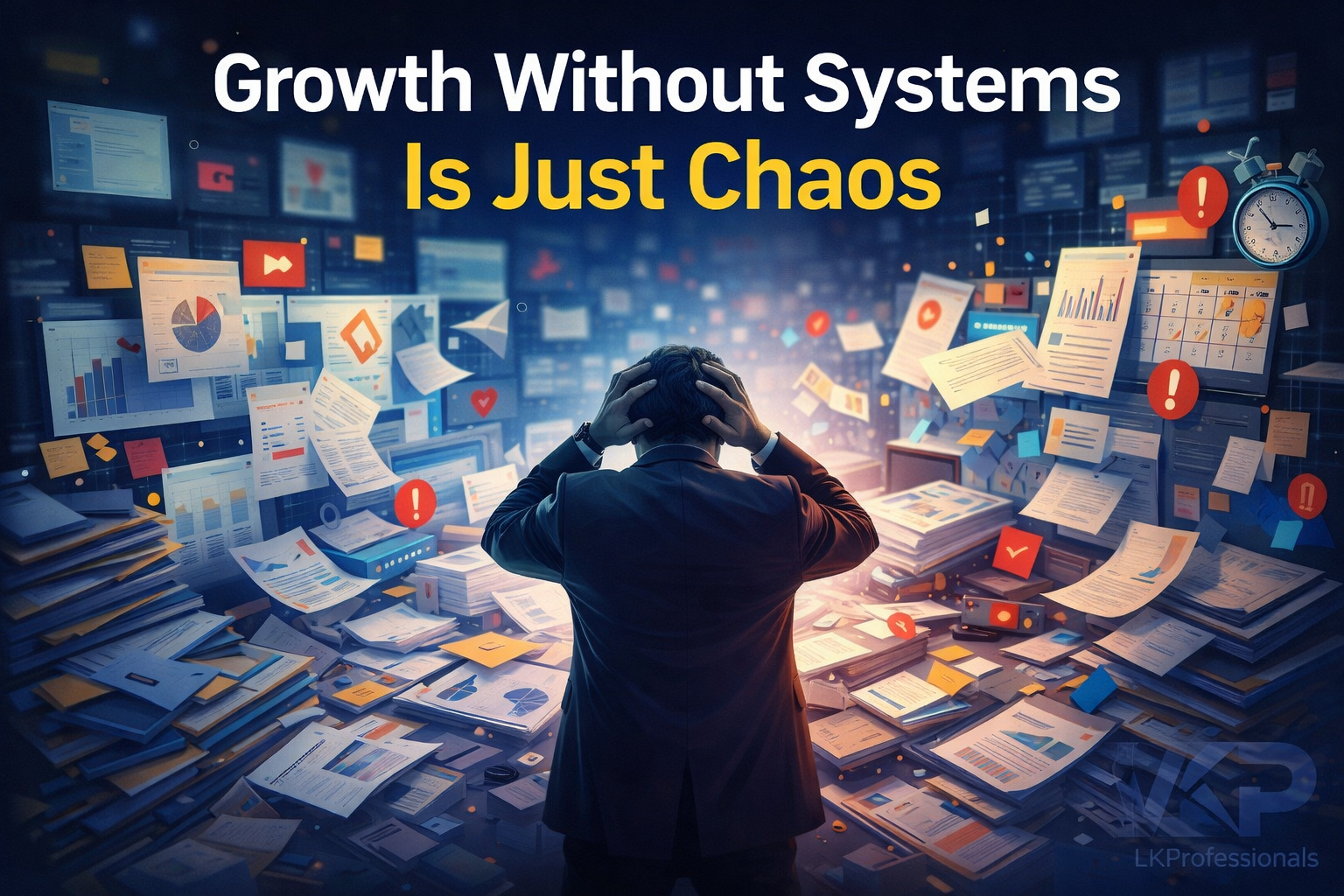
Discover why growth without systems leads to chaos and how structured processes help businesses scale efficiently and sustainably.


Build Something Exceptional
Web, software, mobile, and growth systems tailored to your business.
Discover why growth without systems leads to chaos and how structured processes help businesses scale efficiently and sustainably.
Direct Answer
Discover why growth without systems leads to chaos and how structured processes help businesses scale efficiently and sustainably.
Article Context
Category
Business Growth & Strategy
Author
Janon Emersion T
Reading Time
6 min read
Key Takeaways
Growth feels like success—until it turns into chaos.
Discover why businesses fail to scale without systems and how structure becomes your ultimate advantage.
The Illusion of Growth
Growth looks good from the outside.
More clients. More projects. More revenue. More messages coming in than you can reply to. It feels like momentum. It feels like validation. It feels like you’re winning.
But here’s the uncomfortable truth most founders don’t want to hear:
If your growth is not backed by systems, you are not scaling—you are slowly losing control.
What many businesses celebrate as “growth” is often just increased complexity without structure . And complexity without structure is chaos. Not immediately. Not dramatically. But gradually, quietly, and then all at once.
Deadlines slip. Clients get frustrated. Teams get overwhelmed. Founders get buried in operations. And suddenly, the very thing you worked for—growth—starts working against you.
This is not theory. This is pattern recognition.
And if you’re honest, you’ve seen it too.
Growth vs. Scalability: Two Very Different Games
Let’s call it out clearly.
Most businesses confuse growth with scalability .
Growth is adding more. Scalability is handling more—without breaking.
You can grow without systems. In fact, many businesses do. They hustle harder. They stretch their team. They manually patch problems. They survive.
But scalability? That demands discipline.
A scalable business doesn’t rely on effort. It relies on structure. It doesn’t depend on individuals remembering things. It depends on systems executing things.
Growth says: “We got more clients.” Scalability asks: “Can we handle 10x this without collapsing?”
If the answer is no, you’re not scaling—you’re stacking pressure.
The Early Wins That Create Long-Term Problems
In the early stages, chaos is tolerated.
Actually, it’s rewarded.
You respond fast. You take on everything. You improvise. You wear ten hats. And it works. Clients are happy. Money comes in. Momentum builds.
But here’s the trap:
What works at 5 clients will destroy you at 50.
The same flexibility that helped you survive early becomes the reason you can’t scale later.
No structured onboarding? Clients keep asking the same questions.
No project workflow? Deadlines become guesswork.
No communication system? Messages get lost.
No tracking? You don’t even know where things stand.
At a small scale, this is manageable.
At scale, it becomes operational chaos.
What a “System” Actually Means (Not the Textbook Version)
Let’s strip the corporate jargon.
A system is not a tool. It’s not software. It’s not a dashboard.
A system is a repeatable way of doing something that produces consistent results without relying on memory or improvisation.
It answers three questions:
What needs to be done?
Who is responsible?
How is it executed every single time?
If your business depends on someone “remembering” or “figuring it out,” that’s not a system—that’s a risk.
Systems remove guessing. They reduce friction. They standardize execution.
And most importantly—they protect your business from itself .
The Silent Killer: Operational Bottlenecks
Every growing business hits a wall.
Not because of lack of demand—but because of lack of structure.
You start seeing patterns:
Work piles up in one stage
One person becomes a bottleneck
Clients wait longer than expected
You’re constantly firefighting instead of leading
This is where most founders make a critical mistake.
They think: “We just need to work harder.”
No. You don’t need more effort. You need better systems.
Because bottlenecks are not people problems—they are process problems .
Inside a Growing IT Company: The Reality of Chaos
Take a typical growing IT services company.
At first, everything is manageable:
A few web projects
Direct communication with clients
Tasks tracked mentally or in scattered tools
Then growth hits.
More clients come in. Multiple projects run simultaneously. Expectations rise.
And suddenly:
Client requirements are not clearly documented
Developers are waiting for instructions
Revisions go back and forth endlessly
Deadlines are unclear
Communication becomes fragmented
The founder becomes the central hub.
Everything flows through them. Every decision. Every clarification. Every escalation.
This is not leadership.
This is operational overload disguised as control .
And it is not sustainable.
The Turning Point: When Growth Becomes a Burden
There comes a moment in every business where growth stops feeling exciting and starts feeling heavy.
You’re busy—but not productive. You’re growing—but not in control.
This is the moment where you either:
Step back and build systems or
Continue pushing forward and burn out
Most choose the second option.
Because building systems feels slow. It feels like stopping. It feels like “losing momentum.”
But here’s the paradox:
Slowing down to build systems is the fastest way to scale.
The Core Systems Every Business Needs (No Exceptions)
Let’s be direct. These are non-negotiable.
Not just getting leads—but managing them. From first contact to conversion, every step must be defined.
Every new client should go through the same structured process. No confusion. No missing information. No repeated questions.
Clear workflows. Defined stages. Assigned responsibilities. No guessing where things stand.
Where do conversations happen? How are updates shared? Random WhatsApp messages are not a system.
Consistent content. Structured campaigns. Measurable performance. Not “post when we feel like it.”
Revenue, expenses, margins—tracked properly. Growth without financial clarity is dangerous.
If even one of these is missing, your growth has a weak foundation.
The Myth of Talent Over Systems
Many businesses rely heavily on “good people.”
And yes—talent matters.
But here’s the truth:
Talent without systems creates dependency. Systems with talent create scalability.
If your business collapses when one person leaves, you don’t have a strong team—you have a fragile system.
Systems ensure continuity. They reduce reliance on individuals. They make performance predictable.
Do Systems Kill Creativity? Absolutely Not.
There’s a common fear:
“Systems will make us rigid.”
Wrong.
Systems don’t kill creativity—they create space for it .
When repetitive tasks are structured, your team has more mental bandwidth to think, innovate, and improve.
Without systems, creativity is wasted on fixing problems that shouldn’t exist.
From Busy to Scalable: The Real Shift
A busy business is reactive.
A scalable business is structured.
Busy businesses:
Chase tasks
React to problems
Depend on constant supervision
Scalable businesses:
Follow systems
Prevent problems
Operate with clarity
The difference is not effort. It’s architecture.
Case Study: From Chaos to Control
Let’s break it down.
Before systems:
Projects were handled individually
No standardized onboarding
Communication scattered across platforms
Founder involved in everything
Result:
Delays
Miscommunication
Stress
Limited capacity
After implementing systems:
Structured onboarding forms
Clear project workflows
Centralized communication
Defined roles
Result:
Faster delivery
Better client experience
Reduced founder dependency
Ability to handle more projects
Nothing magical happened.
No new team. No sudden investment.
Just systems.
Where to Start If You’re Already in Chaos
If your business feels messy right now, don’t try to fix everything at once.
Start here:
Identify your biggest bottleneck
Document the current process
Standardize it
Improve it over time
Systems are not built in a day.
They are built through iteration.
The Cost of Ignoring Systems
Let’s not sugar-coat it.
If you ignore systems:
Growth will plateau
Clients will leave
Teams will burn out
You will become the bottleneck
And eventually, you will hit a ceiling you cannot break.
Not because of lack of demand—but because of lack of structure.
The Future Belongs to System-Driven Businesses
The market is evolving.
Clients expect speed. Consistency. Professionalism.
Businesses that rely on chaos will struggle.
Businesses that build systems will dominate.
Because in the long run, execution beats intention.
Every single time.
Conclusion: Structure Is Not Optional—It’s Survival
Growth without systems is not impressive.
It’s unstable.
And instability is expensive.
If you’re serious about building something that lasts, something that scales, something that doesn’t depend entirely on you—
Then systems are not optional.
They are the foundation.
A Strategic Note
At LKProfessionals (Pvt) Ltd., the focus has always been beyond just delivering services.
It’s about helping businesses transition from manual, chaotic operations to structured, scalable systems —whether through web platforms, automation, or digital transformation strategies.
Because in today’s landscape, the businesses that win are not the busiest ones.
They are the most organized.
Apply This Insight
Need implementation support? Talk to LKProfessionals about turning this strategy into measurable business outcomes.
Related Services
Related Insights

Business Growth & Strategy
A practical guide to choosing a software partner in Jaffna for business owners comparing development partners, with clear advice from the perspective ...
Read article
Business Growth & Strategy
A practical LKProfessionals guide to how to prepare for a software quotation, with clear decision criteria, common risks, and the commercial questions...
Read article
Business Growth & Strategy
A practical LKProfessionals guide to cybersecurity governance for SMEs, with clear decision criteria, common risks, and the commercial questions busin...
Read articleRequest Quote